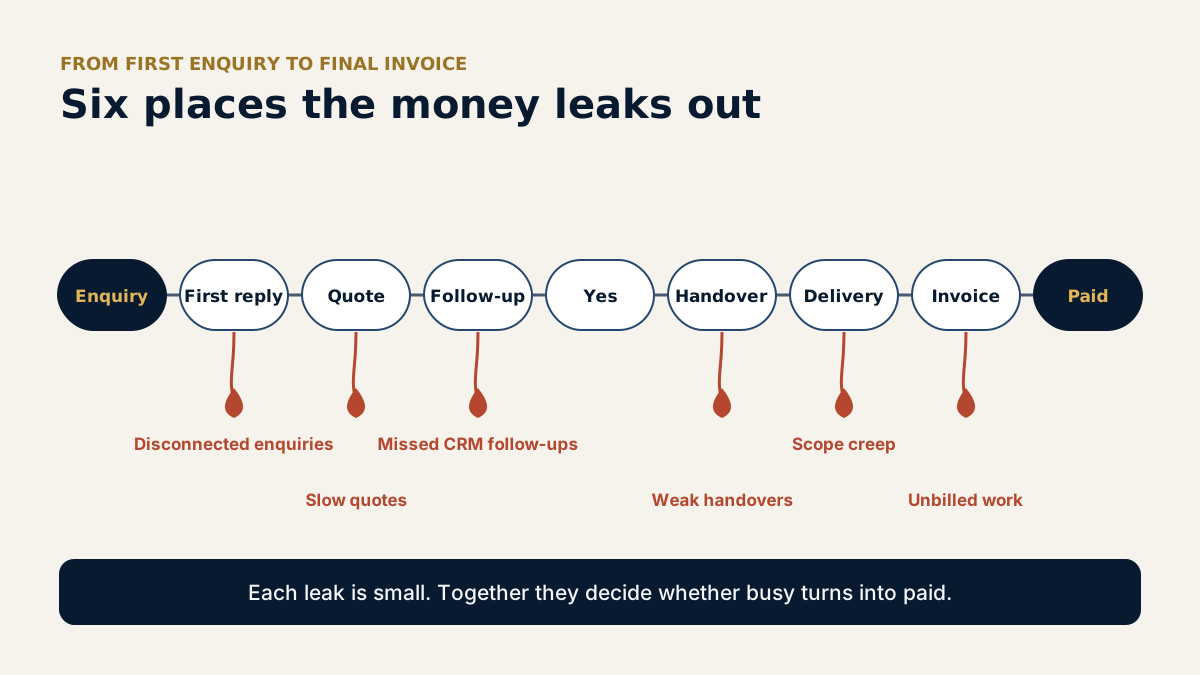
Follow one ordinary enquiry through your business and you can usually spot the leaks in an afternoon. Here is the route, and the six places I check first.
1. The enquiry lands where nobody is watching
Enquiries arrive by website form, email, WhatsApp, Facebook and a call to someone's cellphone. When there is no single place they land, some wait days for a reply and a few never get one. The client rarely complains. They simply buy from whoever answered first.
Quick check: take last month's enquiries. Can you say, for each one, who replied and when?
2. The quote takes longer than the client's patience
A quote that needs three people, a spreadsheet and the owner's sign-off tends to arrive after the client has moved on. Speed matters most while the client is still deciding.
Quick check: how long did your last five quotes take, from request to sent?
3. Nobody follows up, so the quote quietly dies
Most lost quotes are not rejected. They are forgotten, by both sides. Without a follow-up date in a CRM, or at least on a shared list, follow-up depends on memory, and memory is busy.
Quick check: how many quotes sent in the last 90 days have no recorded outcome?
4. Sales says yes, delivery hears something else
The client was promised a start date, an extra or a discount. Delivery finds out in week two. The rework that follows is unpaid, and the client's confidence takes a knock it did not need.
Quick check: is there a written handover for every new client, and does the person delivering the work read it?
5. The job grows, the fee doesn't
One more meeting, one more round of changes, a small extra that "won't take long". Each is reasonable on its own. Together they turn a fixed fee into a discount nobody agreed to. We wrote more about this in how to stop scope creep without losing good clients.
Quick check: compare the time you estimated with the time you spent on your last five jobs.
6. The work is done, but the invoice is not
Finished work waits for someone to raise the invoice. Call-outs and extras are forgotten. Every week of delay makes the money a little harder to collect, and a few invoices never go out at all.
Quick check: match last month's finished jobs to invoices raised. Every gap is money to collect.
Adding it up
None of these leaks looks dramatic on its own, which is exactly why they survive. A business can be busy, well liked and still short of cash because of them.
The good news is that each one has a simple first fix, and most need a routine more than new software. If you want to see how many apply to you, our free Revenue Leakage Checklist scores 25 of them in about 15 minutes.
Follow one of your own enquiries with us
In a 101 Review we trace a real enquiry from first contact to payment, mark where it leaks, and send you the first fix in writing within 24 hours.
Filed under: Business Operations & Commercial Performance. Related service: Business Operations & Commercial Performance
This article is general guidance, not financial, tax or legal advice.